

DAVID OAKEY’s working relationship with Interface stretches back to 1994, and in the 30-plus years of collaboration since, the founder of David Oakey Designs has created countless carpet tile patterns for the commercial flooring manufacturer.
He has also – naturally, of course – witnessed considerable changes to the industry in that time.
When asked how the process of developing a new product has altered over the years, Oakey states it’s two to three times quicker today to move through the prototype and production phases compared with two – never mind, three – decades ago.
‘We can take an idea into a prototype really fast – the first sample we can get would be within days. Then the actual production would go on the floor within weeks,’ he says.
‘When I [first] studied carpet design in England, it would take me three weeks to draw a design with paint. Then it’d take me another three weeks to take that design and paint it in little squares so that they could cut the jacquards. And that would be another three months, and eventually we would get the product six to nine months from then.
‘But the problem with that was, if you didn’t like it, you had no choice!’
Today, he continues, it’s possible to prototype three or four different ideas for a collection before committing to one that feels the most exciting. This, in Oakey’s view, leads to the creation of better products.
Progress, however, can have its drawbacks. He mourns, for example, the decline of the carpet manufacturing industry in his home town of Kidderminster, which he says was once ‘a bustling’ place. And later, before he launched David Oakey Designs in 1984, there was a time when technology, despite its evident advantages, disillusioned him.
He explains: ‘I was so into computerised design that there was a period when I lost my way – because we weren’t making products that I could feel and touch. It was all on the computer. We would print out the design – and yes, it was a pattern we were making – but it had no texture, no feel.
‘When I started my own company, I let go of some of the technology and went back to actually making samples by hand. I just wanted to be able to touch and feel.’
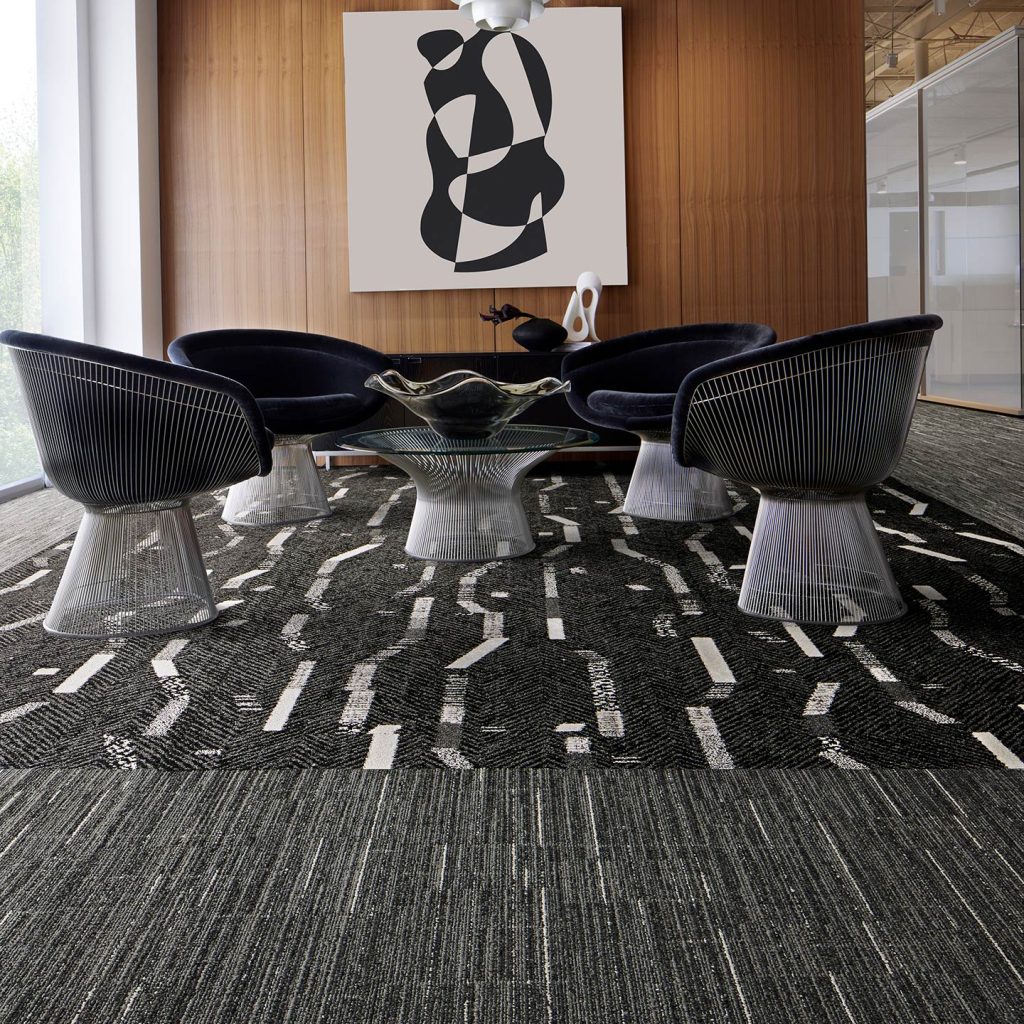
Oakey’s latest carpet tile collection, exclusively designed for Interface, is called Dressed Lines. Inspired by post-war modernism and 1950s fashion, the likes of Anni Albers, Charles and Ray Eames, Lucienne and Robin Day, Raymond Loewy and Florence Knoll have all influenced the approach to texture and contrast evident in the collection.
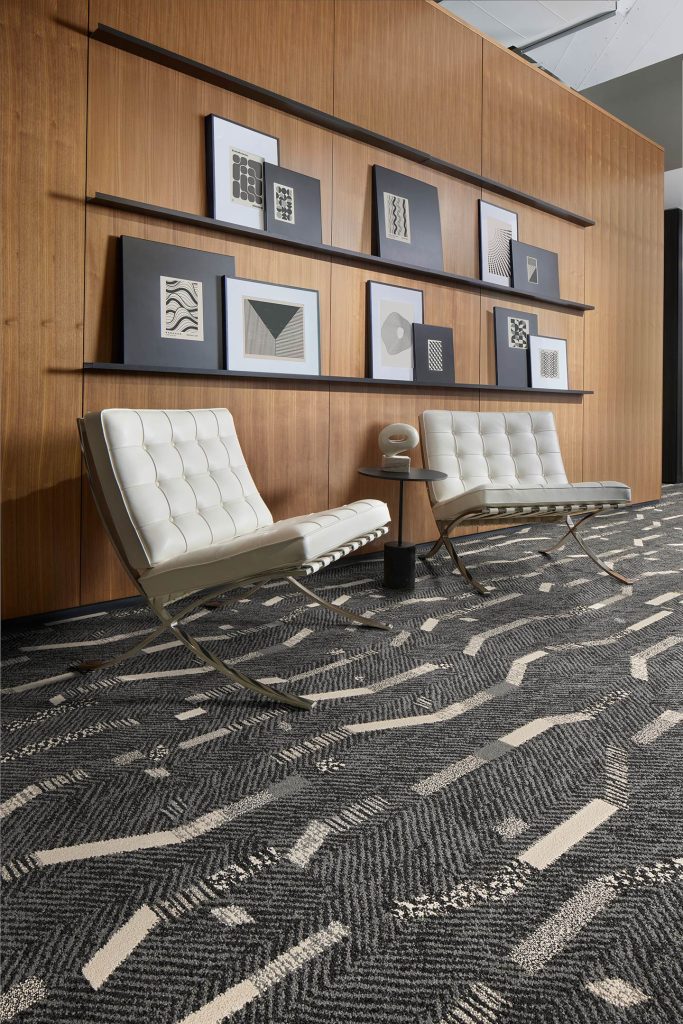
‘The patterns are sophisticated, small scale and high contrast,’ says Oakey. ‘We wanted the carpet to styles to seem like dress fabric.
They’re versatile, ranging from subtle, tailored looks to bold, black and white accents.
‘It’s intriguing how these post-war modern looks have such staying power. Miller Knoll has the Florence Knoll chair – it’s 60 years old and they’re still selling it – and as designers we have to consider how the new designs we create complement these classic pieces. This was top of mind during the development of Dressed Lines.’
The collection features six styles with eight complementary colour combinations, ranging from warm neutrals to, as Oakey says, high contrast accents. It includes Goes Around and Comes Around, two foundational styles featuring patterns that build on each other, with two, distinct, pinstripe looks reminiscent of formal wear. Both products are offered in 25cm x 1m formats. Angular Times and Accent Hour feature angular patterns and pops of white accents and are also offered in 25cm x 1m formats. Meanwhile, Simple Does It and Positive Spin both provide versatility, pairing texture and contrast with speckled and cubed designs.
These styles are available in 50x50cm formats.
‘We created Dressed Lines to address the versatile needs of our customers,’ says Oakey. ‘At one end of the spectrum are very subtle subdued styles that work best in open areas; at the other end are bolder, more complicated designs that make for great accent or focal points.’
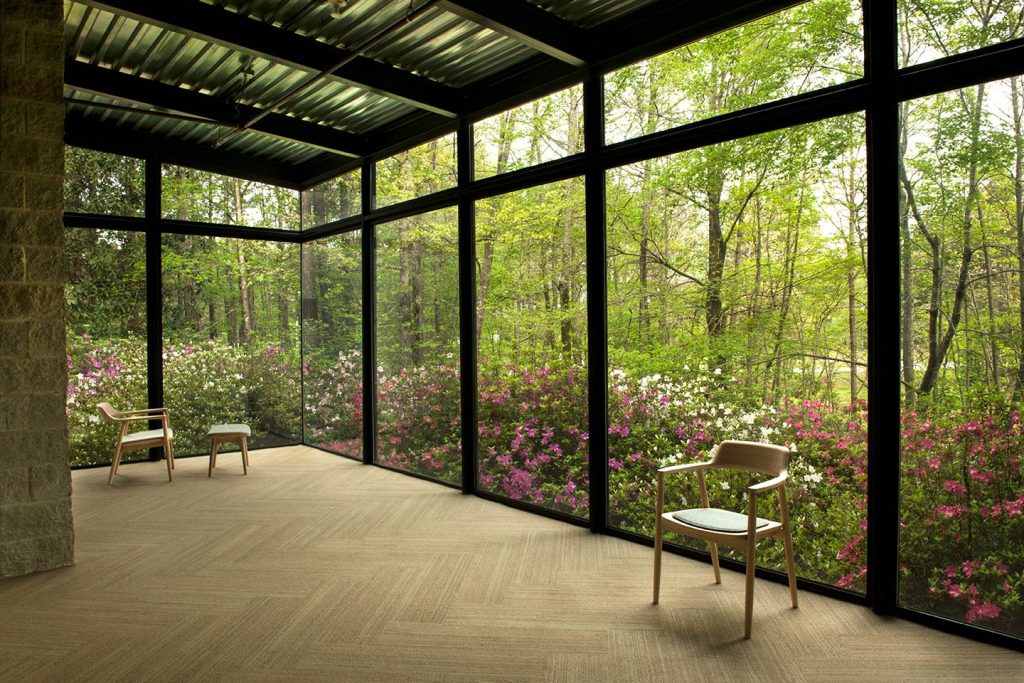
Oakey works from his Pond Studios. Designed by Elva Rubio and built in 1996, in Georgia, US, the 15,000ft2 structure is situated within six acres of forest, and features skylights and windows oriented to the seasonal movement of the sun, with most of the glazing facing north to avoid summer heat build-up.
A geothermal system controls heating and cooling. There’s also a cantilevered deck overlooking a pond, after which the studios are named. When summer comes and the vegetation thickens, the building is ‘pretty much in a cocoon’.
‘We love our building. We love to go to work there,’ says Oakey. ‘Today, people need to think of the workspace as a destination, not as a place that you have to go to. It needs to be like a beautiful hotel with a view – whether it’s over the sea or the mountains. You have to have a space that not only looks great, physically, but has amenities where you want to be every morning.
‘And we’re connected with nature,’ he continues. ‘It’s a beautiful place to be, mainly because of the biophilic influence. We enjoy it every day we come in.’
Oakey is well-versed in the role that nature can play in design.
In 1994, Ray Anderson, the founder of Interface, set the company on path towards embracing sustainability. It was around that time that Oakey was introduced to a book called Biomimicry: Innovation Inspired by Nature, by Janine M Benyus. The author became a mentor and friend.
The combination of both events changed Oakey ‘completely’ and led eventually to the creation of Interface’s I2 Entropy carpet tile in 2000, and subsequently several natured inspired designs since. ‘It was really about learning from nature,’ Oakey has said about the I2. ‘We had the first workshop ever at [the studio] with Janine Benyus and her group. They asked the question: how would nature design the carpet tile?
‘Everything in nature is diverse and different – so we started to think about as a team how we could make a carpet tile that was slightly different.’
For Oakey, nature-inspired design – whether it’s biomimicry or biophilia – is about how people feel in a space: ‘There’s enough scientific evidence to know that when people spend more time in nature, they feel different. Like the old Victorian hospitals in London – there was as much design for the gardens as the hospital to get patients outdoors.
‘We know we feel better close to nature.
We live in these artificial interiors – whether it’s your home, your car, an office – where we have lights that don’t change, we have indoor temperatures that stay exactly the same. Can you bring some of that natural feeling into an interior – whether you want to bring plants or design with natural elements?
‘Outdoors, the colour changes from morning to night, from day to day, from year to year. We have flowers in the spring. All those elements would be great to bring to the interior. My dream one day is that the interior space will feel just like you took a walk and that you have that breeze in your face – and you say, ‘well, that felt good’.
‘How you do it? Technology? I don’t know how, but whatever you do, as far as bringing more natural elements to the interior space, the better it can be.’
With so many years of working in the industry behind him, the obvious question to ask is just how he remains motivated to keep producing new carpet tile designs?
The answer is that he and his wife – and trend analyst – Cindi Marshall Oakey love to travel and soak up inspiration.
‘We love to go to exhibitions, we love to go to trade shows,’ he says. He admits to occasionally thinking he might be suffering from a creative block. ‘And then, the next day,’ he says, eyes sparkling, they see somewhere, such as Arabia Mountain – part of the Arabia Mountain National Heritage Area, in Georgia, US, which his son insisted he visited during the era of Covid – and the creativity begins to flow again.
Long may it continue.


