

THE ‘PLAY OF BRILLIANTS’ is how pioneering US lighting designer Richard Kelly famously described lighting that moves beyond purely functional, ambient illumination. It is one of the three core tenets – along with focal glow and ambient luminescence – that Kelly defined as the essential elements of a successful and carefully balanced lighting scheme.
The phrase (probably self-explanatory) describes the magical effects of light, its reflection and refraction, its interplay with surfaces and materials. ‘Play of brilliants is Times Square at night,’ said Kelly. ‘It is an 18th-century ballroom with crystal chandeliers and many candle flames. It is sunlight on a fountain or a rippling brook. It is a cache of diamonds in an opened cave. It is the rose window of Chartres… Play of brilliants excites the optic nerves, and in turn stimulates the body and spirit, quickens the appetite, awakens curiosity, sharpens the wit…’
The first two projects here – Facets in Chiang Mai and The Cross of Heroes in Ukraine – are the epitome of the phrase, with light, both electric and natural, lending sparkle, colour and visual exhilaration. The third project is, on the face of it, more about glow than glitter – though producing ‘a kinetic play of shadows and highlights’ – but again it powerfully demonstrates the ability of light to make the mundane magical.
Facets Café, Chiang Mai, Thailand
Design and Lighting: BB Workspace
In the grounds of a gemstone retail outlet in San Kamphaeng, Chiang Mai, Facets is a café that has been both renovated and extended. The design is inspired by gemstones and literally reflects the ‘brilliance of light’.
‘The design translates the forms, colours and reflective qualities of gemstones into built form, while subtly integrating local cultural identity,’ says BB Workspace interior design director and co-founder Jarasphong Cheuapool.
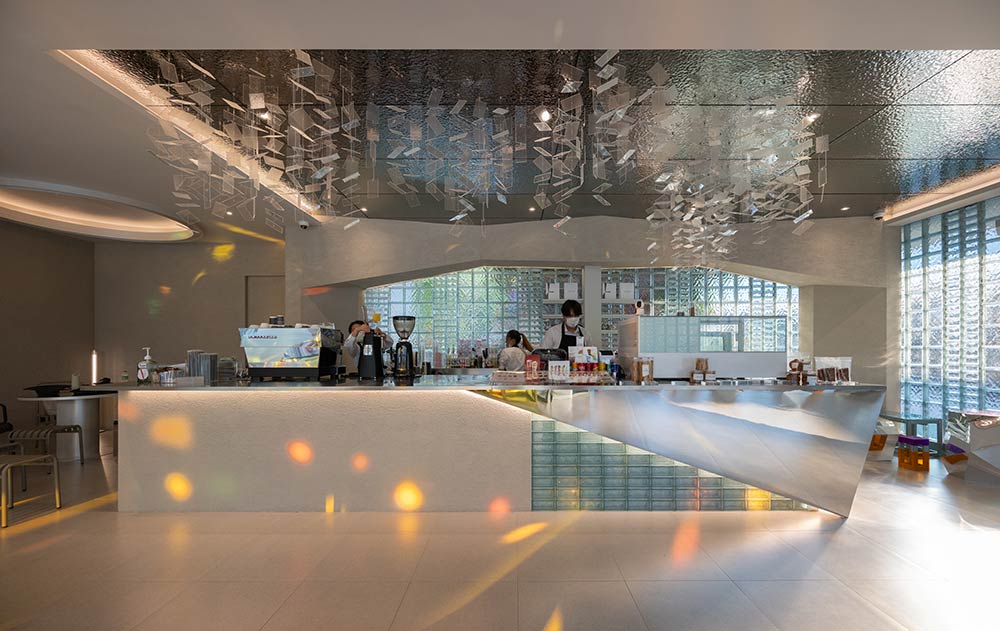
The existing building has been transformed into a crystal-like mass using two sizes of clear glass blocks arranged in alternating patterns. The interior is designed to echo an unrefined or unpolished gemstone. Certain wall elements are shaped to resemble stone caves, with textured surfaces evoking natural geological strata. The overall palette is white with reflective materials, symbolising the purity of crystalline forms.
A medley of materials is used, from rippled aluminium to glass and acrylic, offering a range of reflectances for the light to play on. The serving counter is sharply faceted and clad in mirrored aluminium, producing a luminous floor reflection. Acrylic panels are suspended from the ceiling, swaying with the air and catching the light at shifting angles.
Furniture pieces resemble raw stone forms, wrapped in glossy laminates and coloured acrylics that reference specific hues of gemstones, lending the space vibrancy while maintaining transparency and airiness.
The palette of white, silver and translucency allows the interior to softly glow at night, and is designed to evoke the radiance of a gemstone within a display case.
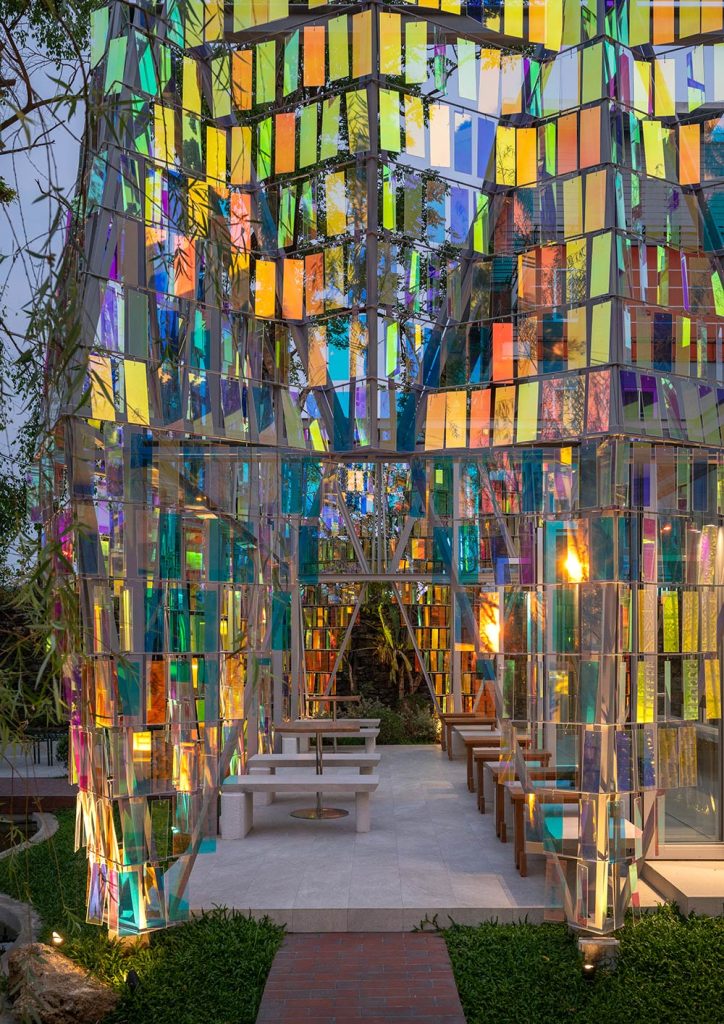
The new extension was inspired by the faceted geometry of a diamond, featuring a steel structural frame clad in acrylic panels coated with dichroic film. These iridescent panels shimmer and their colours subtly shift according to the sun’s angle and time of day, ‘turning the building envelope into a living jewel that glows and dances with light’.
The garden is simple and serene, leafy green plants acting as a softening foil to the building’s geometry. Locally crafted materials are used, including handmade clay bricks to create the gently curved walls. A free-form pond offers a further opportunity for play of light, weaving between the outdoor seating areas, reflecting and animating the architecture. www.bbworkspace.co
The Cross Of Heroes, Vyshgorod, Ukraine
Lighting Design: Expolight
The Cross of Heroes, in a city just north of the capital Kyiv, is a monument to those who have given their lives defending Ukraine after Russia’s invasion. It is also dedicated to those who continue to fight for the country’s future.
The heart of the concept is the Cossack cross, a version of the Templar cross. In modern times it has been adopted and adapted by the Ukraine military as part of the emblem of the armed forces, and has been used for medals and memorials.
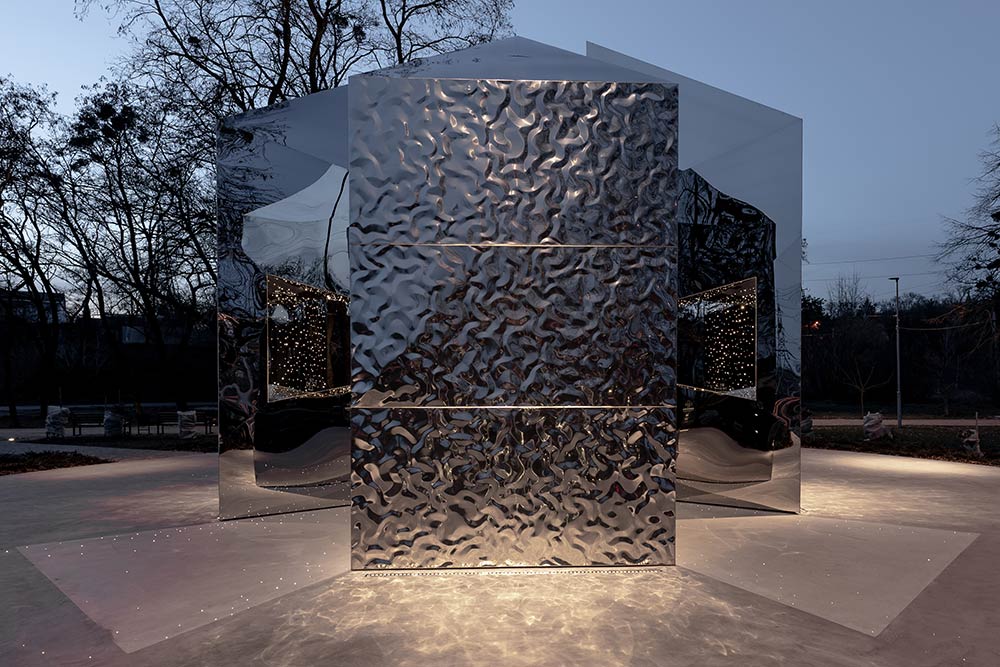
A symbol of ‘victory and protection’, the aim was to inscribe the structure in a circle, allowing the viewer to experience it from both the outside and in the centre, accessing it from each of the four sides.
Kabluka Light and Digital Sculptures (part of multidisciplinary studio Expolight, which was co-founded by Mykola and Olena Kabluka) developed the concept and architectural design of the installation, as well as the masterplan for the location and its implementation.
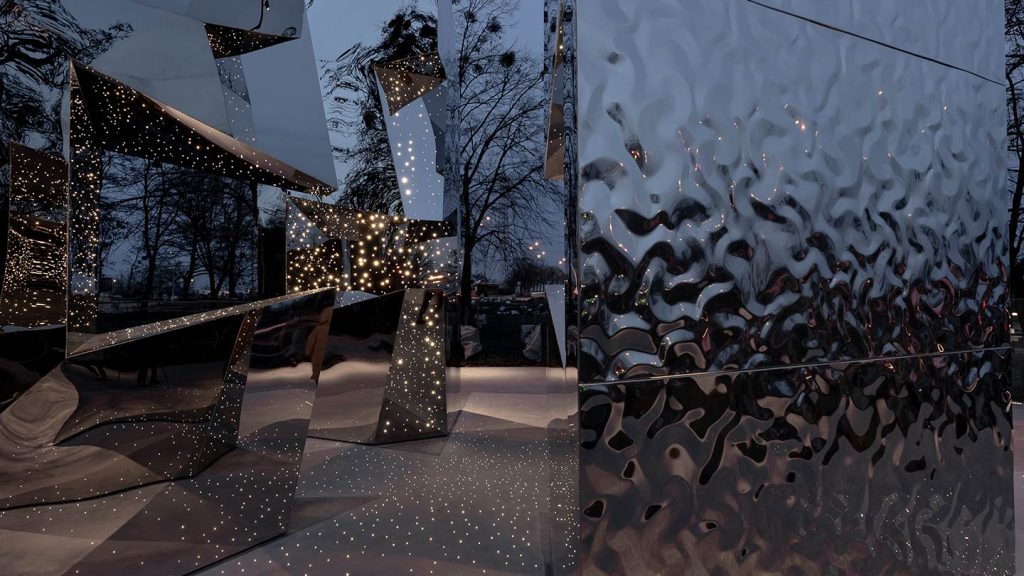
The complex, three-dimensional structure forms the shape of the cross both on the paving and in the spaces between the individual elements. There is an audio component, experienced at the centre of the memorial – based on sounds associated with different parts of Ukraine, ‘from the whispering noise of forests to the melodic sounds of Carpathian streams’ – but the concept is primarily based on optical and light effects.
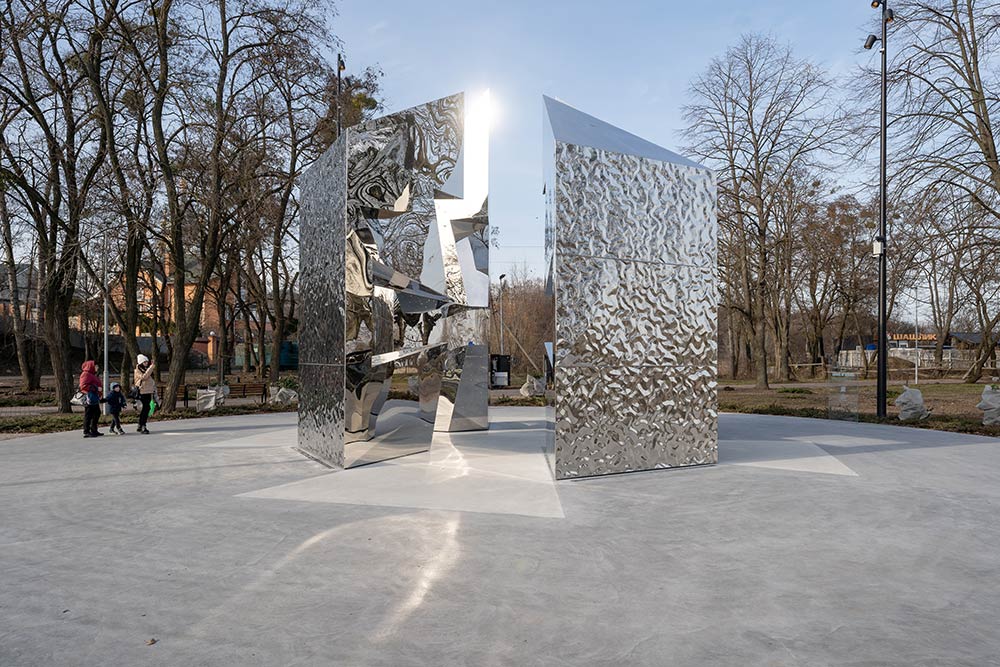
Fibre-optic lighting is integrated into the paving and the form itself. The mirrored edges both interact with their surroundings and reflect each other. The wavy metal surfaces are positioned in such a way that in any season and weather they catch sunlight with a certain symbolic meaning.
‘We paid a lot of attention to light,’ says Expolight. ‘With light, we enhance the sacredness of the installation and create conditions for maximum immersion in the context… Being inside the installation, among thousands of lights, a person experiences an emotional symbolic experience of unity with the nation of which he or she is an integral part.
‘The light elements represent the souls of the heroes who sacrificed themselves to protect Ukraine, and all those who make efforts to dispel the darkness with their light.’ www.expolight.net/en/project/cross-of-heroes
Zhangbei Mirage, Zhangbei County, China
Lighting Design: Puri Lighting Design
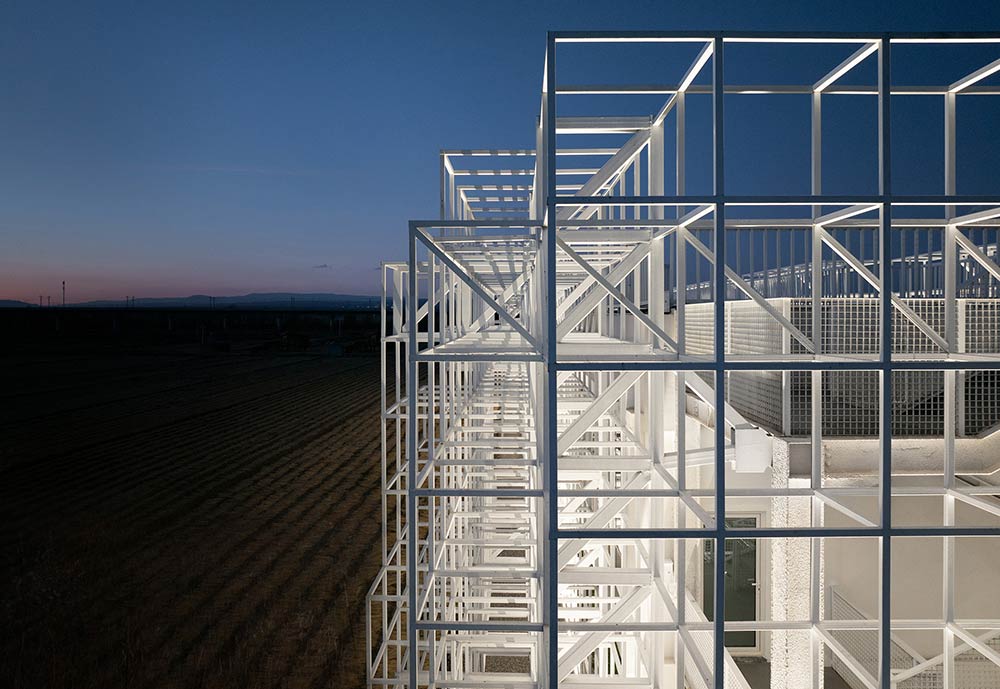
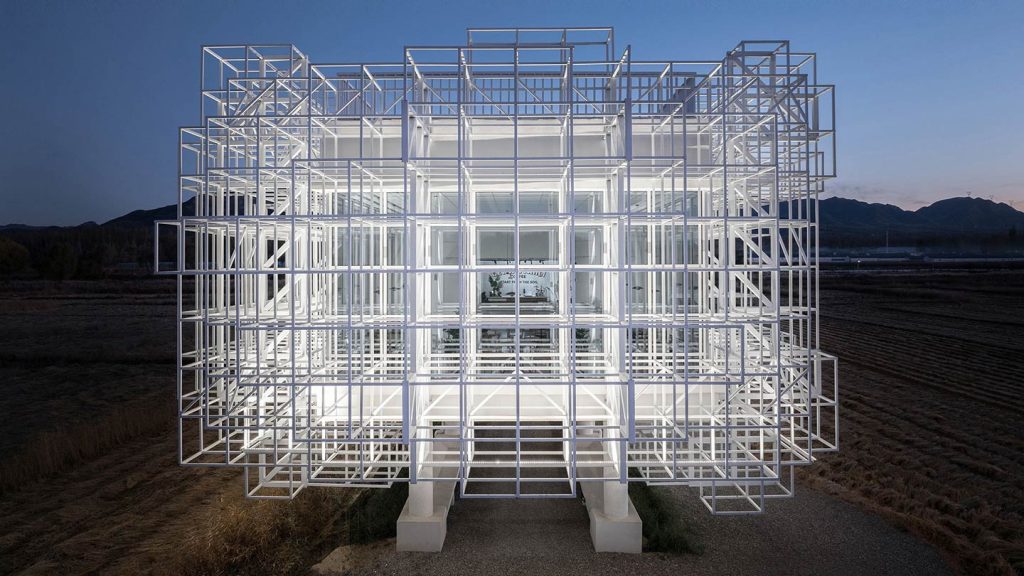
Designed by Beijing-based Buzz, Zhangbei Mirage, a cultural centre north-west of Beijing in Hebei province, sits isolated in a vast open field. Puri’s scheme plays on the contradictory structural qualities of the building – heavy concrete enveloped by a lighter geometric metal steel framework – turning its after-dark appearance into what it describes as ‘a vessel of light’. The scheme relies on precision and integration.
‘Our approach centred on amplifying the building’s inherent duality: solidity versus weightlessness,’ says Puri. ‘We created a luminous exoskeleton by integrating uplighting directly into the steel framework.’
Light fittings have different wattages and precise beam angles – including 36W with a 10º beam, and 48W with a 30º beam – which were angled to project light upward, emphasising the structure’s geometric lattice. ‘This technique achieves a nuanced contrast,’ says Puri. ‘While the interior glows softly, the exterior’s uplighting is intentionally more pronounced, injecting dramatic depth. The result is a kinetic play of shadows and highlights that enhances the building’s transparency and lightness, making it appear to hover above the grassland at dusk.’ www.purilgt.com/projects/Cultural/ Zhangbei-Mirage
The Trick Principle

One of the more ingenious fittings to introduce an element of visual playfulness into schemes in recent years is Trick by iGuzzini, designed by award-winning lighting designer Dean Skira. Its latest, and fifth, iteration is Trick Em.
The cleverness of the Trick principle lies in innovative optics, which allow a single fitting to throw its beam 360º – lighting an entire window conceal, for instance, or simultaneously throwing a line of light on ceiling, floor and both walls of a corridor. ‘Its main function is not to create general illumination or answer to specific mathematical requirements to illuminate the space; instead it’s something to be played with,’ says Skira.
With inbuilt DMX and multi-projector beam, Trick Em can produce sequences and rhythms of moving light, creating graphic patterns that can highlight and emphasise different architectural features at different moments or simply animate the space.
The new optics are divided into ten autonomous and multifunctional segments, with 360º movement, that can be controlled or managed separately. Eight preset lighting scenes are available, and customised lighting scenes can be created.
In interior and exterior versions, the fitting can be wall, ceiling or ground-installed. www.iguzzini.com/trick-em


