

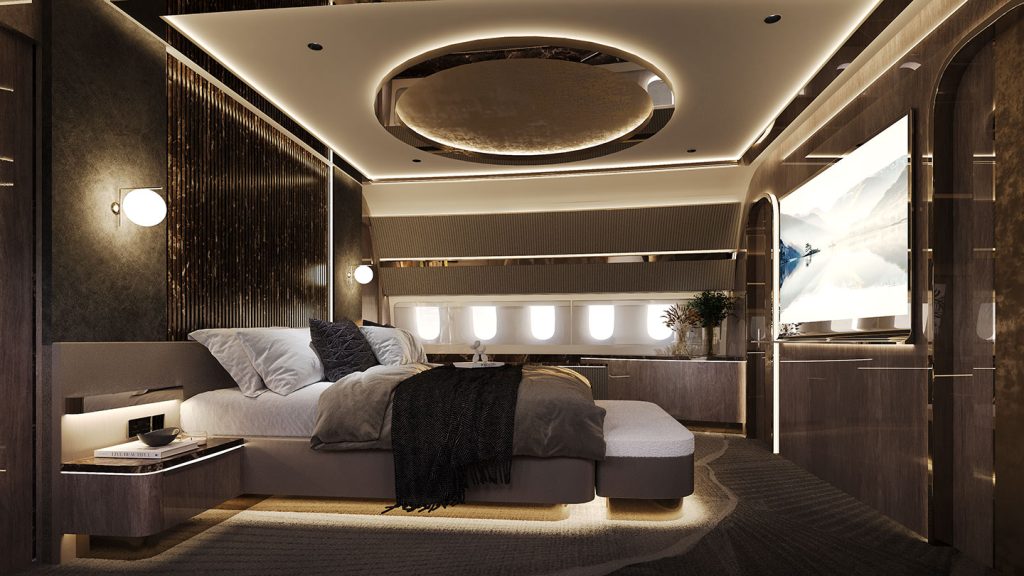
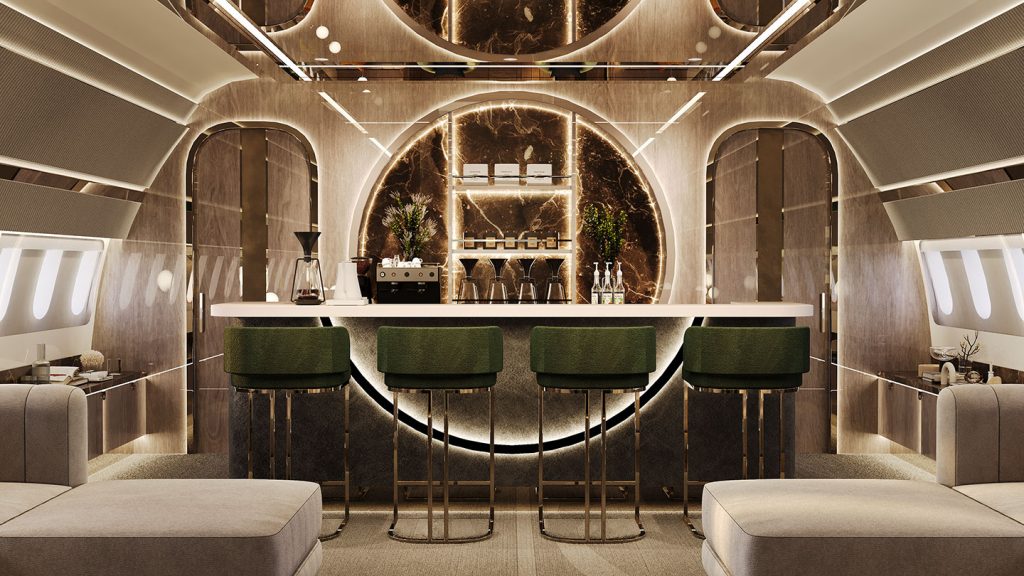
EARLIER THIS year, the US luxury aircraft interior designer Natalie Rodríguez unveiled a stunning new interior concept for the Boeing 787-8 Dreamliner – the long-haul, wide-body jet favoured by heads of state and ultra-high-net- worth individuals. Reimagining the aircraft’s 2,458ft2 interior as a five-star boutique hotel suite, Solrise includes a spacious lounge, three bedrooms, dining and conference area, concealed cinema and a sleek coffee/cocktail bar. In the main lounge, amidst wood veneers, antiqued metal accents and merino wool and silk carpets, are four divan seats upholstered in fawn fabric and complemented by another four fully articulating accent seats in olive green. The elegant master bedroom boasts a king-size bed, while dark Emperador marble surfaces add textural depth and elegance to the sanctuary-like space. Cove lighting, soft under-seat illumination and circular ceiling fixtures create a refined sense of opulence throughout. For those wanting superior luxury and comfort, Solrise showcases the pinnacle of elite interior design possibilities.
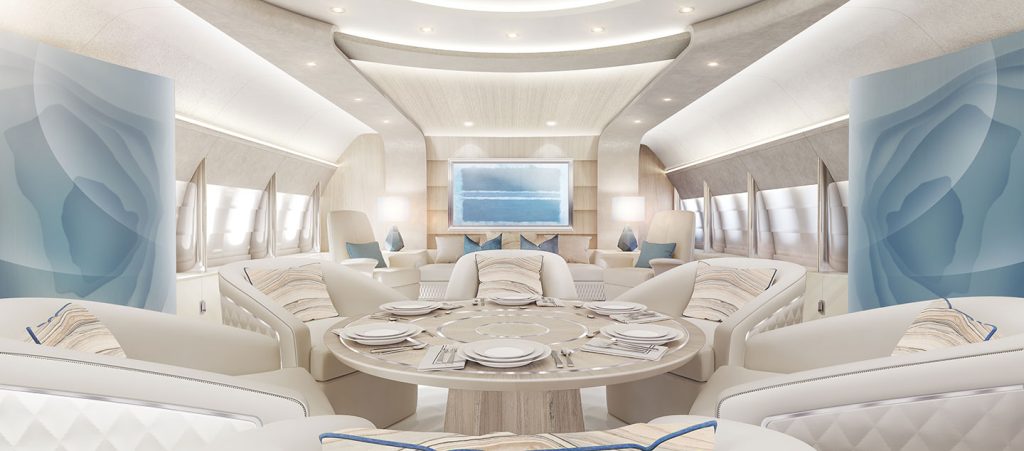
With an extensive background in VVIP (very very important persons) completions and refurbishments for Boeing Business Jets (BBJ), Natalie Rodríguez Luxury Design is part of an exclusive group of design studios that work with the most discerning of clients at the very top of the international business jet sector. Another of the company’s breathtaking BBJ concepts is Haven. Employing a refined palette of white, ash grey and gold, it features a VIP lounge with walnut-accented coffee tables; an eight-place dining area with angular high-back chairs; a show kitchen with shaker millwork-inspired cabinets and a freestanding Carrara marble island bar; a master bedroom featuring a gold-studded headboard upholstered in grey tufted silk-mohair; and a bathroom with porcelain basins, backlit mirrors, sconce lights, and a double rain head shower. The residential-inspired design allows for large group entertainment, mixology and high-end culinary experiences, reflecting the combination of luxury, comfort and individual expression that private jet owners have come to expect.
Natalie Rodríguez and her peers, including Winch Design, M&R Associates Design and Camber Aviation Management, have elevated luxury aircraft interior design to an art form.
But private jets weren’t always as luxurious. In the 1950s, the fledgling industry was focused on function over form, with small aircraft such as the Beechcraft D18S being a popular choice for personal and business use; its standard green leather seats offered a modicum of luxury for the time but there were no options for customisation. It was during the 1960s that private aviation really began to come into its own, with the foundations being laid for a rapidly evolving industry marked by innovation, expansion and an increasingly refined flying experience for upmarket travellers.
In 1962, the Lockheed JetStar became the first dedicated private jet to enter service, but it was the Learjet 23, launched the following year by US entrepreneur William P. Lear, that captured the market for fast and efficient small business aircraft. Indeed, the Learjet’s futuristic design and offer of unparalleled speed and privacy proved irresistible to the rich and famous who used it to travel between glamorous engagements, international meetings and holiday retreats. Yet despite its large, oval windows, the cabin interior was relatively cramped and its decor somewhat utilitarian. Influenced by its Swiss fighter jet origins, the Learjet emphasised speed and efficiency over luxury and sophistication. Nevertheless, a divan, drinks cabinet and card table provided basic comfort and entertainment. In 1967, the Gulfstream II set a new standard for luxury and convenience with its large cabin, leather upholstery, private telephone, air conditioning, television and multi-speaker sound system.
As the desire for more lavish interiors grew, many ultra-rich individuals began looking to buy even larger aircraft. In 1969, Playboy founder Hugh Hefner fitted out a McDonnell Douglas DC-9 jetliner, painting it black and essentially transforming it into a flying Playboy Mansion, complete with living room, conference area, circular bed and, of course, a fully stocked bar and dance floor for partying at 30,000ft. The aircraft became emblematic of Hefner’s hedonistic lifestyle, and it paved the way for even more high-flying opulence and luxury in the years to come.
Open-plan layouts would become the standard in the 1970s, offering flexible spaces for work, leisure and dining. Lounges provided more room to move around and the inclusion of conference areas fitted out with desks allowed business users to work and hold important meetings in-flight.
In 1973, a Boeing 720 passenger jet designed to carry 138 passengers was bought by the US singer Bobby Sherman and his manager Ward Sylvester, who converted it into a lavishly equipped private aircraft called The Starship. They created a luxurious cabin with a long couch down one side, swivel chairs and a 30ft brass-trimmed drinks bar. A television and Sony U-Matic videocassette player with a library of films provided entertainment, while a bedroom with a queen-size waterbed and opulent white fur bedspread could be found at the back of the plane. The Starship was rented out to world-famous celebrities, most notably the British rock band Led Zeppelin, who used it frequently. On each flight, the band and their guests enjoyed an open bar, often supping vintage Dom Pérignon champagne and tucking into gourmet meals prepared by a private chef. The Starship became a symbol of success and extravagance in the music industry and was chartered by other superstars including John Lennon, Bob Dylan, Elton John, The Rolling Stones and Frank Sinatra. However, the energy crisis of the mid- 1970s left the aircraft grounded. Too expensive to run, it went into storage in 1977 and was eventually dismantled.
The 1980s heralded a new era in private aviation with the introduction of long-range jets such as the Gulfstream III and the Dassault Falcon 900. These jets, which could fly non-stop intercontinental journeys, opened up new possibilities and transformed the way that high-end businesses operated globally.
The following decade saw significant technological advancements with jets such as the Gulfstream V, launched in 1997, capable of travelling from New York to Tokyo in a single flight. In the late 1990s, Bombardier’s Global Express series came to market, offering a coveted blend of performance and luxury. This era also saw major leaps forward in plush interiors with clients increasingly able to customise cabin spaces to their taste. High-end furnishings and upholstery made from materials including fine leather, silk and cashmere became popular choices, as did exotic wood cabinetry and panelling, and bespoke rugs and carpets.
Increasingly, VVIPs have wanted aircraft to reflect the comfort and aesthetic of their luxury homes. Amenities such as home cinemas, underfloor heating and spa-like bathrooms have joined plush bedrooms, fully equipped conference areas and high-tech workspaces with ultra-fast Wi-Fi on jets such as the Cessna Citation Longitude, Dassault Falcon 10X and Bombardier Challenger 650.
Some aircraft even feature dedicated fitness spaces with exercise bikes, rowing machines and other wellness amenities. From the 2010s, smart technology has enabled passengers to travel in even more comfort by allowing them to take control of the cabin environment, adjusting the lighting, temperature and window shades. More recently, innovations such as the AeroPortal system by Ingenio Aerospace have advanced the possibilities for cabin tech. Its certifiable plug-and-play technology eliminates the need for costly, custom integration, allowing residential-grade light fittings to be installed without compromising design integrity.
Although today’s aircraft manufacturers provide off-the-shelf options for cabin interiors, often with pre-designed modules that can be mixed and matched to suit, many customers opt to enlist the services of an external design studio. But this is not conventional interior design; rather it is a complex and exceptionally specialised integration of aesthetics, function and technological innovation. Multiple parties are involved in the process, from the aircraft manufacturer, to the design studio, to completion centres and the client themselves, whose individual requirements and preferences drive each project. Furthermore, jet interiors are a highly technical domain and so creative possibilities need to be reconciled with strict regulatory obligations that dictate what can and cannot be installed on a plane.
To say it’s something of a minefield would be an understatement. Indeed, from concept to delivery, a bespoke interior can take up to two years to complete.
The process begins with selecting the right aircraft that meets the client’s needs.
Then comes the concept phase, focusing on the owner’s precise requirements. For instance, do they want a private work area, a place for entertaining, a bedroom with en-suite, or all of these? And is there a specific aesthetic preference, perhaps drawing from a favourite car interior, the luxury finishes of a yacht, or even the client’s own home? The aim is to develop a design that not only fulfils the owner’s travel requirements but also reflects their personal taste and individuality.
Once the concept has been decided upon, the designer’s initial sketches show how the client’s preferences could be configured within the aircraft’s layout, along with suggested materials and stylings. The skill here is in developing a layout that maintains good flow where, unlike interior design on the ground, factors such as weight restrictions and aviation regulations must all be taken into account.
The final look is shaped through the careful selection of materials and finishes, ensuring that each choice meets both functional and regulatory requirements. Digital 3D models enable all parties to assess and fine-tune the proposed interior, after which precisely scaled drawings and detailed technical specifications ensure that the design can be accurately realised within budget and timescale. Once all of the required systems, finishes, and performance standards have been agreed, final revisions are made before the design is formally signed-off and the construction and installation begins. Some private jet owners may want to go further and customise their interiors with works of art, in which case they may enlist the help of an art consultancy such as British company Artelier, which specialises in aviation certified art and regularly work with executive aviation users, operators and manufacturers.
Among its bespoke art projects is a stunning integrated mural for a Bombardier Global 5000, created in collaboration with Winch Design. Painted directly onto the aft bulkhead, the artwork was part of an ambitious business jet refit that transformed a standard cabin into a unique statement of personal expression. The vibrant painting, which was commissioned from a London based artist, took inspiration from the Japanese abstract painter Kazuo Shiraga (1924-2008). Its dynamic blend of bold colours and subtle geometries set the tone for the whole cabin and are reflected throughout, from the custom tufted carped and embossed stitched leather bulkheads to the high-quality leathers used for the seats. In terms of materials, it was necessary to work within strict aviation guidelines. The artist used a specialised paint formula designed to be flame retardant and able to withstand significant environmental challenges, such as temperature and air pressure fluctuations.
Furthermore, the whole panel needed to be sturdy enough able to withstand the forces of turbulence. While the gestural painting may appear to be a spontaneous creation, it in fact required several prototypes and rigorous safety testing before it was signed off.
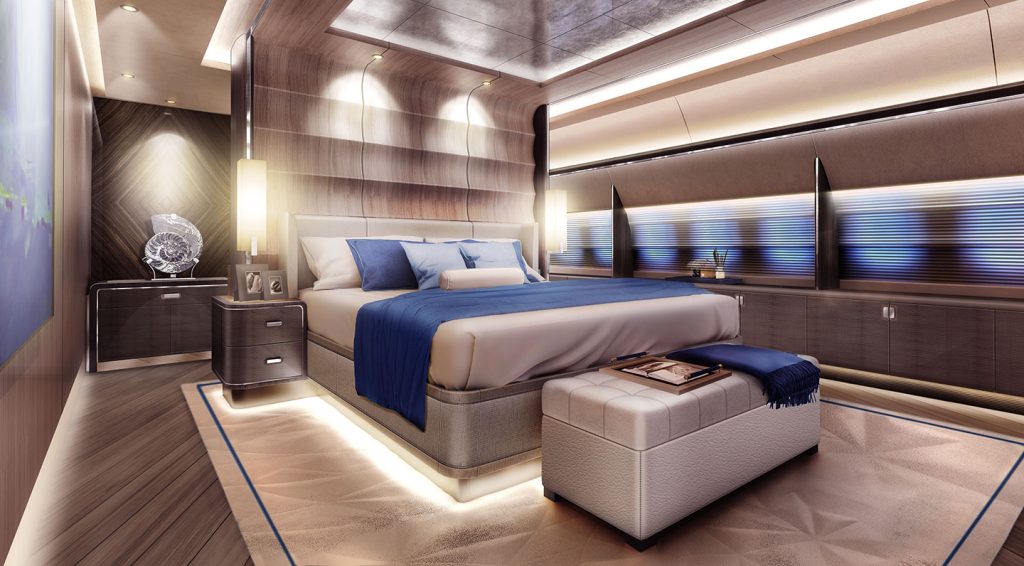
The London-based Winch Design, with its 100-strong team of designers, has worked on numerous interiors for aircrafts, as well as super yachts and luxury homes. Its personalised cabin designs exude refined luxury and comfort, elevating the onboard experience to exceptional levels. The firm’s dedication to elegance and superior craftsmanship is reflected in BBJ aviation concepts such as Mayfair, which takes inspiration from London’s most luxurious hotels and offers an adaptable and spacious open-plan design. Its fully bespoke interior employs dark high-gloss veneers, superior leather upholstery, satin almond gold fixtures, fine linens and Loro Piana cashmere. As with Natalie Rodríguez, Winch is a company at the top of its game. And just as today’s breathtaking interiors would have been inconceivable to the first generation of private jet owners, the future promises even more innovation, particularly in the area of sustainability, greener technologies and the implementation of AI into in-flight services, further enhancing the flying experience. The history of private aviation teaches us that what seems unimaginable today may well become reality tomorrow.


